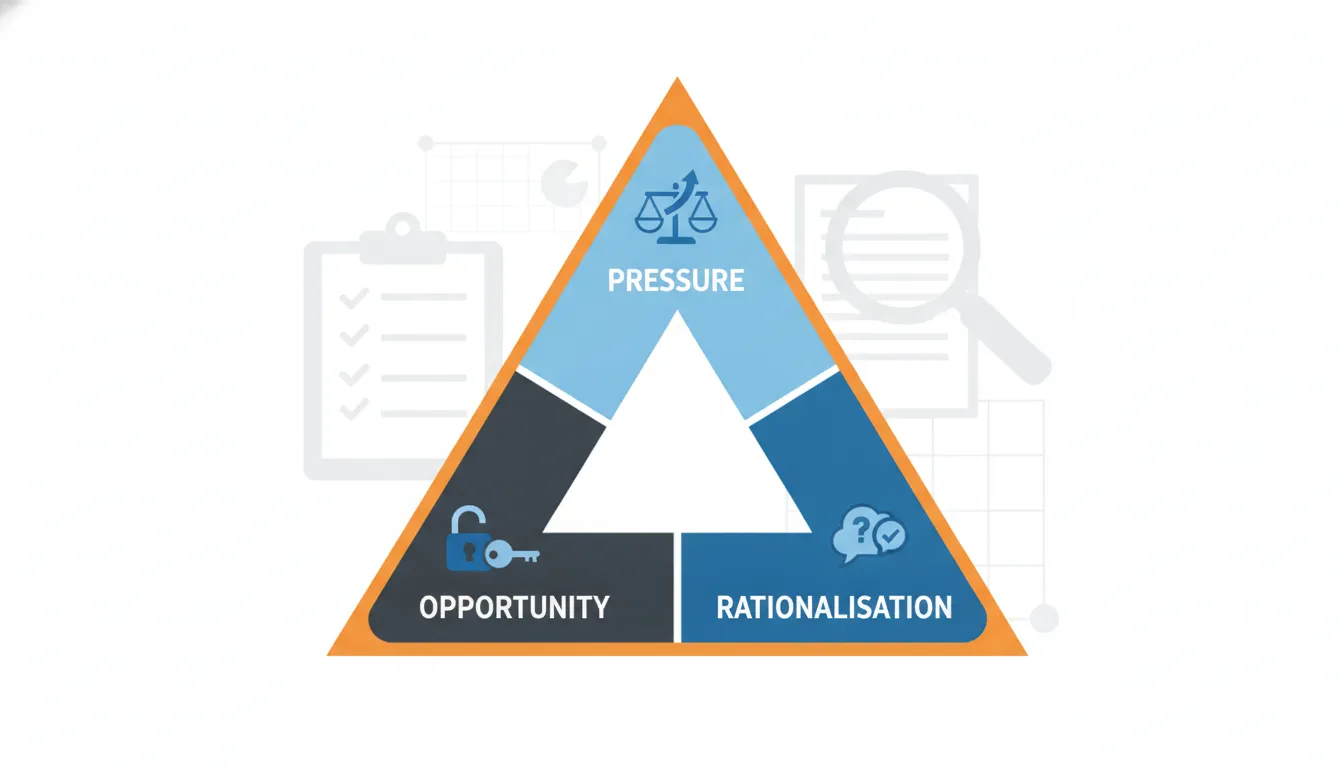
The fraud triangle is a crucial concept in auditing, accounting, and fraud prevention. Understanding the very essence of fraud, the fraud triangle is a concept that discusses three conditions that are frequently available at the same time: pressure, opportunity and rationalisation.
A business, an auditor, and a manager can easily understand the concept of fraud risk and thus create good preventive controls only when they know the three factors that determine it. It is also significant's that CPAs and accounting students can correctly classify the fraud risk factors, especially when they are able to distinguish between fraudulent financial reporting and misappropriation of assets.
Table of Contents
- Step 1: Understand what the fraud triangle is
- Step 2: Learn why pressure is the first side of the fraud triangle
- Step 3: Understand how opportunity makes fraud possible
- Step 4: Recognise how rationalisation completes the triangle
- Step 5: See how the fraud triangle works in a real corporate example
- Step 6: Distinguish financial reporting fraud from asset misappropriation
- Step 7: Use the fraud triangle to classify risk factors correctly
- Step 8: Know the controls that help break the fraud triangle
- Step 9: Avoid common misconceptions about the fraud triangle
- Step 10: Apply the fraud triangle in auditing and business decisions
- Step 11: Review the key takeaways
Step 1: Understand what the fraud triangle is
The fraud triangle is a framework devised by criminologist Donald Cressey to interpret the presence of the conditions widely found with fraud cases.
The model does not assert that the occurrence of fraud is automatic whenever one of these scenarios prevails. Rather, it claims that the fraud risk increases when the three are concurrently in place.
-
What motivates people to commit fraud is the adverse situation or encouragement besides the stress.
-
Fraud can only occur through the availability of opportunities.
-
Rationalization makes it possible for a person to explain the act.
This framework is valid for both primary types of fraud mentioned in auditing:
-
Even when i earn, i still have some debts.
-
{Misappropriation of assets}, including taking cash or other company property without authorization.
Step 2: Learn why pressure is the first side of the fraud triangle
The main factor that makes a person feel propelled towards fraud is pressure (also known as incentive or motivation). This pressure is largely financial in many cases, albeit sometimes it can be stressed due to expectations, targets or can be affected by personal problems.
Generally, individuals do not engage in fraudulent activities without a reason. Frequently, the source of such actions is some hidden inclination, pressure, or goal that serves as the driving force.
Common pressure factors in fraudulent financial reporting
Management in the public companies may have strong motivators to make the business look healthier than it really is. Often this is due to the following factors:
-
The term refers to the situation when the company fulfills the sales or profit goals set by the investors or analysts.
-
Preventing a decrease in the company's stock rate after promising excellent performance
-
Following debt covenants that are required by lenders.
-
Persistently being attached to the profit or the stock performance of rewards or bonuses.
-
Achieving stability in a growing reputation is by protecting it.
An illustrative situation could be a situation where a firm is anticipated to disclose, E/P, 2.00 but is virtually above net profit, E/P, 1.90, management will be abandoning their integrity out of pressure to arrange the items correctly or to balance the book.
Common pressure factors in misappropriation of assets
In cases where fraudulent actions involve misappropriation of currency or assets, the stress is frequently individual. Some notable incidents are:
-
Heavy personal debt
-
Gambling problems
-
Financial stress that exceeds normal income
-
Personal commitments the worker feels incapable of fulfilling.
A cashier having a substantial gambling debt and holding cash readily is one of the classical stressor or driver incentive risk factor for asset misappropriation.
Step 3: Understand how opportunity makes fraud possible
Opportunity is a condition that facilitates fraudulent activity. A person may undergo some pressure, but the absence of an effective method to perform and hide the fraud, the risk is lower.
Opportunities are most often the result of such things as weak internal controls, inadequate oversight or too much access to assets or financial reporting systems.
Examples of opportunity in organisations
-
Weak monitoring of fraud risks
-
Lack of independent checks over company assets
-
Poor segregation of duties
-
Insufficient oversight by management
-
Too much authority concentrated in one person
In financial statement fraud, a senior executive can bypass controls or can disguise a transaction, thus, the opportunity may exist.
In asset theft situations, it is possible that the perpetrator would create some sort of loophole just for their convenience when an employee is involved in cash handling, making journal entries, and doing account reconciliation tasks by himself/herself without independent review.
Why opportunity matters most in prevention
Pressure and rationalisation are hard to remove as they usually reside within the individual. Conversely, opportunity is distinct. Organizations have the option to lessen it directly through enhanced controls.
The major reason behind the emphasis of fraud prevention on control design, supervision and monitoring is their most significant focus.
Step 4: Recognise how rationalisation completes the triangle
Rationalization refers to the technique or skill that enables an individual to convince their mind or their justification is true and ethical and fraud or cheating is something that is not a big deal at all. Even when a person is aware that the act is unlawful, they might be able to find an argument that would lower negativity or guilt.
Most frequently, this is the most challenging thing to identify as it takes place within the body.
Common rationalisations behind fraud
-
"It is only temporary."
-
"I am just borrowing the money."
-
Everyone profits due to the company looking attractive.
-
"Analysts or lenders imposed unreasonable conditions on us."
-
Now, it is only a temporary measure until we finish one quarter.
-
"We are more competitive than our rival companies, so this is just equalizing the competition."
-
"I should get a higher salary than I am getting right now."
The starting process at the senior level of management is actually the place where rationalisation becomes the most dangerous. For instance, when senior leadership regards matters of ethics as of minor importance when compared to results, this dress can spread throughout the company and infect the entire control environment.
Step 5: See how the fraud triangle works in a real corporate example
A classic example of a financial reporting scandal is the one that took place with Enron top executive Andrew Fastow. The scenario demonstrates that the three sides of the fraud triangle can indeed collaborate.
-
+The pressure of the financial incentive was due to the fact that the company performance and the stock value was to the point that the was at the point it was at the point the company's personal financial interests were tied to the company's.
-
Chance: out of the 1 year in total as CFO ht had the power and the entry to access change the financial structure and reporting.
-
Internal justifications such as that the manipulation could be seen as temporary or that it would be corrected in the future were the rationalisations.
This approach was to use complex structures to hide the debt and losses, which makes the balance sheet look stronger, and at the same time, the financial results seem to improve overall.
This is a useful example as it illustrates that fraud is not merely about the greed of a person. It usually consists of a combination of incentives, access, and self-justification.
Step 6: Distinguish financial reporting fraud from asset misappropriation
One of the most frequent hurdles not only during examination but also in real life is the accurate classification of fraud risk.
Fraudulent financial reporting
This is a scenario where the presentation of financial statements is done with deliberate falsehoods. The objective is often to present the company as being more robust, as and having higher profits or even being more stable than it actually is.
Typical pressure factors include:
-
Analyst expectations
-
Debt covenant compliance
-
Executive compensation tied to profit
-
Protecting market reputation
Misappropriation of assets
It is all about the theft or inappropriate us of company's resources like cash, inventory, etc., or other assets.
Typical pressure factors include:
-
Personal debt
-
Gambling losses
-
Financial hardship
The differentiation holds significance since a fact pattern involving the same circumstances can indicate different parts of the fraud triangle in relation to the surrounding context.
Step 7: Use the fraud triangle to classify risk factors correctly
While investigating the risks for fraud, it is advisable to consider two different inquiries.
-
Which kind of fraud was this? It is financial reporting or asset misappropriation?
-
The part of the triangle that the fact describes is related to pressure, opportunity, or rationalization.
This approach helps avoid common mistakes.
Example classification
Risk factor: A cashier has a big amount of personal debt that is a result of gambling.
Classification: Misappropriation of assets; pressure, or incentive.
Risk factor: Inadequate verification on the company's asset thereby leading to misappropriation.
Classification: An opportunity, rather than being pressured.
Risk factor: The management shows a lack of concern to monitor the risk of asset misappropriation.
Classification: Opportunity, as the absence of proper administration provides more chances to commit fraud.
Risks: The employees who have access to assets must take mandatory vacation.
Classification: In this case, there is no fraud pressure factor. Its function is to mitigate fraud risk through a control.
Step 8: Know the controls that help break the fraud triangle
Organisations, of course, are unable to get rid of personal pressure entirely, nor can they exercise complete control on how individuals rationalise misconduct. However, they are capable of cutting down the chances of it happening by adopting stringent internal controls.
Practical anti-fraud controls
-
The separation of duties is a principle of internal control whereby one individual is not allowed to handle or operate all stages of a certain transaction segment personally.
-
Asset, cash, and record verifications and reconciliations practiced independently.
-
Mandatory leaves for employees in sensitive positions
-
Constant tracking of fraud risks and inconsistent transactions.
-
Authority/supervision by the leadership team and governing boards
-
The expectation of high ethical standards is clearly from leadership.
A robust control environment is critical particularly due to the fact that the negative tone at the top can erase the entire organization. In fact, if executives push the employees towards the way of the shortcuts, then they can legitimize dishonesty in their eyes.

Step 9: Avoid common misconceptions about the fraud triangle
Misconception 1: Pressure alone causes fraud
Dealing with pressure is a normal thing for many people. Apart from this, committing fraud also needs the chance and justification.
Misconception 2: Strong performance goals are always harmless
Targets and incentives might serve as the motivating factors for the employees, however, unattainable targets can also act as the fraud pressure.
Misconception 3: Rationalisation is easy to identify
Mind is the hardest to concretely notice—it's difficult to notice it because the process is mostly occurring inside the human being's thoughts.
Misconception 4: Fraud only happens in weak companies
Even the fast growing or widely welcomed companies can experience the risk of fraud when the three elements we mentioned namely pressure, opportunity and rationalisation unite.
Misconception 5: Internal controls only matter after fraud occurs
Internal controls are mainly preventive. Their purpose is to minimize the chances of fraud occurring before any losses take place.
Step 10: Apply the fraud triangle in auditing and business decisions
Considering the fraud triangle, it translates the auditors, accountants and managers' cloudy fears into a tangible risk assessment tool.
It can help you:
-
Identify red flags more clearly
-
Separate pressure from opportunity
-
Get the reason of a specific individual or process being susceptible.
-
Design preventive and detective controls
-
Assess tone at the top and culture risks
Use of this framework in examination environment is explicitly beneficial in multiple choice questions as well as scenario analysis. Far from that, it assists the organization's in conceptualizing fraud risk development better.
Step 11: Review the key takeaways
-
The fraud triangle is made up of pressure, opportunity and rationalisation.
-
The occurrence of all three factors simultaneously causes a rise in the fraud risk.
-
Both fraudulent financial reporting and misappropriation of assets are applicable to the model.
-
Financial stress, market expectations, debt covenants, bonuses, and personal debt are all sources from which one can derive pressure.
-
Weak internal controls and lack of supervision is the major reason for the occurrence of an opportunity.
-
Rationalization is the type of self-deception that one resorts to in order to be able to think about it as a dishonest action that is permitted.
-
The fairest and easy way to diminish fraud risks is to narrow the opportunity through better controls.
Should you want to quickly overview fraud risk analysis, begin with the following checklist:
-
Identify the type of fraud.
-
Look for pressure or incentive.
-
Assess where opportunity exists.
-
Consider possible rationalisations.
-
Consolidate controls at areas with the most significant potential.

