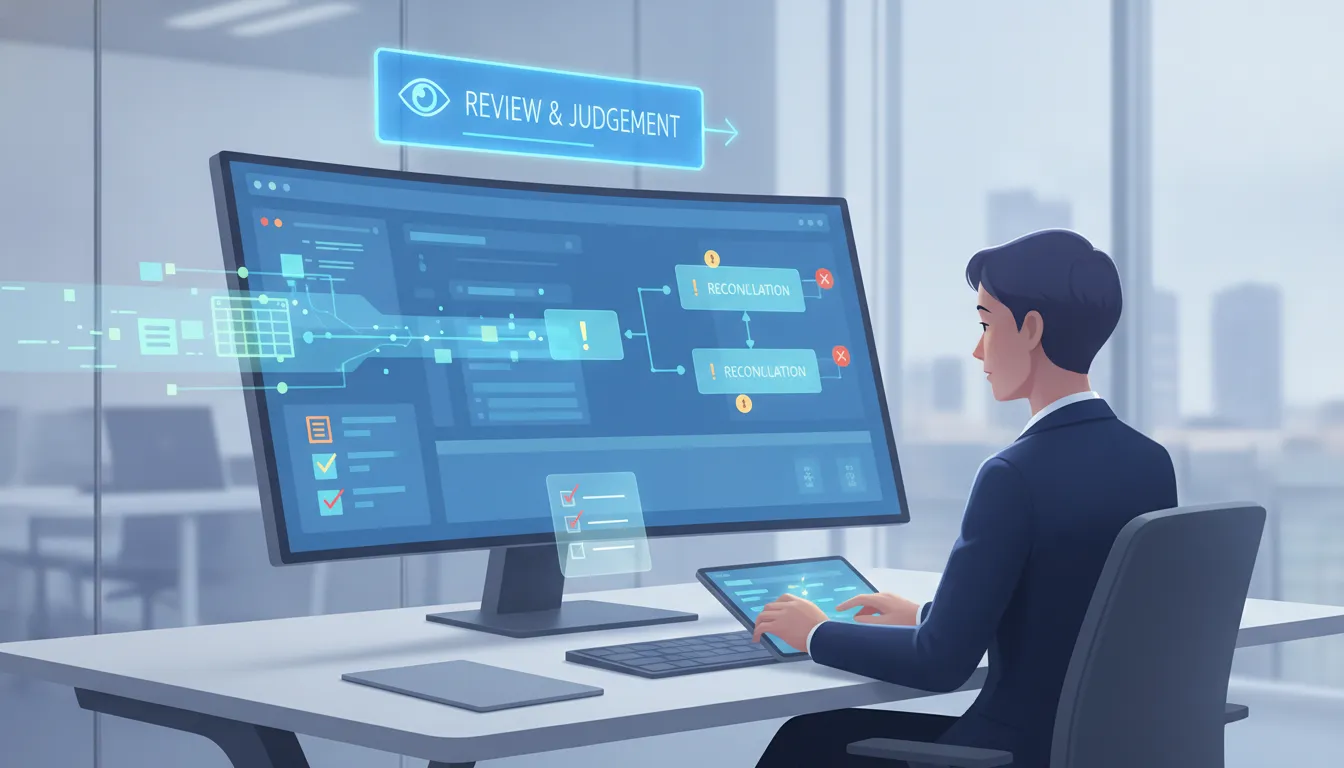
Artificial intelligence is poised to change accounting work substantially, particularly the time-consuming tasks involved in close, reconciliations, data preparation, and spreadsheet analysis. The important distinction is that AI is not simply a replacement for accountants. Its greater potential is to reduce manual workload so finance professionals can spend more time applying judgement, improving processes, and advising the business.
For accountants concerned about career security, the most useful question is not, “Will AI take my job?” It is, “Which parts of my job can AI support, and what higher-value work can I take on as a result?”
Key Takeaways
- AI can automate repetitive accounting work while keeping accountants responsible for judgement and oversight.
- Data processing, reconciliations, comparisons, and aggregation are practical starting points for AI-assisted accounting operations.
- Time saved from manual work can be redirected towards controls, audit readiness, process design, and strategic analysis.
- Accountants who understand AI tools can better advocate for technology investment and career growth.
Table of Contents
- AI in Accounting: A Shift in Work, Not the End of the Profession
- What Will Accountants Do as AI Handles More Routine Work?
- Why AI Is Particularly Relevant During the Financial Close
- Will AI Replace Accountants?
- Skills Accountants Need to Stay Competitive in an AI-Enabled Profession
- How to Start Adopting AI in Your Accounting Team
- Common Mistakes When Using AI for Accounting
- Professional Development Can Help Turn AI Knowledge Into Career Advantage
- The Future of Accounting Is More Strategic
AI in Accounting: A Shift in Work, Not the End of the Profession
A useful way to understand AI’s impact on accounting is to compare it with the tractor’s effect on farming. Mechanisation removed much of the most labour-intensive fieldwork, but it did not eliminate farmers. Instead, it changed how farms operated and created more capacity for planning, crop science, yield improvement, and other specialised work.
AI can have a similar effect on accounting teams. It can help with the foundational work that often dominates a close calendar, including:
- Data entry and data processing
- Preparing and comparing datasets
- Account reconciliation support
- Expense aggregation
- Spreadsheet analysis
- Identifying differences and exceptions for review
These tasks are often essential, but they can consume the time accountants need for work that requires professional expertise. AI can process and analyse information faster than a person can perform repeated spreadsheet lookups, but it does not remove the need for an accountant to evaluate the output, investigate anomalies, and determine the appropriate accounting treatment.
What Will Accountants Do as AI Handles More Routine Work?
As AI takes on more repeatable, rules-based work, accountants can focus on the responsibilities that create greater business value. This is a move away from the outdated “bean counter” stereotype and towards a more strategic business-partner role.
Improve the quality and speed of the close
When teams no longer need to spend as much time gathering data, matching transactions, or constructing recurring schedules, they can focus on closing with more confidence and fewer bottlenecks. Faster processing also gives finance leaders more time to review results before decisions need to be made.
Strengthen controls and reduce single points of failure
Accounting departments can become vulnerable when critical processes depend on one employee’s knowledge or availability. AI-supported workflows can help establish a more durable foundation, while accountants document procedures, improve handoffs, and address control gaps.
This is especially valuable for work that is frequently delayed when a team member leaves, is unavailable during a critical deadline, or simply lacks enough time to complete every task manually.
Support audit readiness and compliance
AI does not eliminate the need for reliable evidence, clear policies, or internal control. It can, however, give accounting teams more capacity to organise support, resolve deficiencies, and prepare for audits. For public companies and companies preparing to scale, that time can be redirected towards quarterly reporting, annual reporting, and Sarbanes-Oxley compliance.
Accountants should remain informed about evolving expectations for responsible AI use, including governance, documentation, and review. The AICPA and CIMA artificial intelligence resources provide broader professional context for AI’s growing role in finance and accounting.
Deliver analysis and recommendations, not just historical results
Accounting teams have traditionally been asked to explain what happened. With more capacity and better access to organised information, they can contribute more directly to questions such as:
- What is driving a material change in results?
- Where are the operational risks or process weaknesses?
- What actions should management consider next?
- Which activities are creating avoidable delays or costs?
This is where accountants become trusted thought partners. Their value comes from combining reliable financial information with business context, judgement, and a practical understanding of operations.
Why AI Is Particularly Relevant During the Financial Close
The financial close is often the clearest example of why accounting teams need automation and AI support. During close, professionals may be reconciling expenses, waiting for source data, investigating variances, preparing entries, and reviewing spreadsheets under strict deadlines.
AI can serve as a virtual assistant for the repetitive groundwork. It can help process information continuously, flag items that require attention, and prepare analysis for an accountant to review. This does not mean the work becomes effortless. It means the team can concentrate its limited time where it matters most.
The strongest use case is not “remove people from the process.” It is give capable people a better process. Accounting leadership still needs to establish policies, set review standards, assign accountability, and make final decisions.
Will AI Replace Accountants?
AI is expected to change accounting roles, but the central opportunity is to remove manual drudgery rather than eliminate the profession. Accounting depends on context, professional judgement, accountability, and the ability to explain decisions to auditors, executives, and other stakeholders.
For example, an AI tool may help identify an unusual variance or compile reconciliation data. An accountant still needs to determine whether the result reflects a legitimate business event, a data-quality problem, a control issue, or an accounting error. The accountant also remains responsible for documenting the conclusion and deciding what should happen next.
AI may raise expectations for accounting teams. Activities that feel like optional improvements today, such as well-documented processes, timely analysis, and stronger operational visibility, may become standard expectations as technology makes them more achievable.

Skills Accountants Need to Stay Competitive in an AI-Enabled Profession
Future-proofing an accounting career does not require becoming an engineer. It requires developing the confidence to understand how AI and accounting transformation tools can improve real finance processes.
1. Learn where AI fits in an accounting workflow
Start with the work your team performs repeatedly. Identify activities that are high volume, manual, structured, and prone to delay. Reconciliations, data preparation, spreadsheet comparisons, and recurring close tasks are natural areas to examine.
Then ask practical questions:
- What information does this process require?
- Which steps are repeated every period?
- Where does review and professional judgement need to remain?
- What exceptions should be escalated to a person?
- How would the team validate that the output is complete and accurate?
2. Build AI literacy, not just tool familiarity
Knowing the name of an AI product is less useful than understanding the underlying workflow. Accountants should be able to explain what an AI-enabled process does, what data it uses, where its limitations are, and how a reviewer retains control.
This knowledge helps professionals assess new technology at their current company and adapt more easily when they move to a different ERP, close-management platform, or accounting environment.
3. Strengthen communication and business-partner skills
As routine work becomes less central, the ability to communicate clearly becomes even more valuable. Finance professionals need to explain financial results, advocate for better processes, and connect technology investments to operational outcomes.
When seeking budget or support for a new system, do not stop at saying that the team needs AI. Explain the use case: the bottleneck it addresses, the work it can support, the controls that remain in place, and the capacity it could create for the team.
4. Keep your accounting foundation strong
Technology changes quickly, but accounting expertise remains essential. Professionals still need to understand financial reporting, controls, audit evidence, policies, and how transactions affect the business. AI can accelerate preparation and analysis, but it cannot replace the accountable professional who understands the accounting implications.
How to Start Adopting AI in Your Accounting Team
Broad AI ambition can feel abstract. A focused, controlled implementation is more useful than attempting to redesign every accounting process at once.
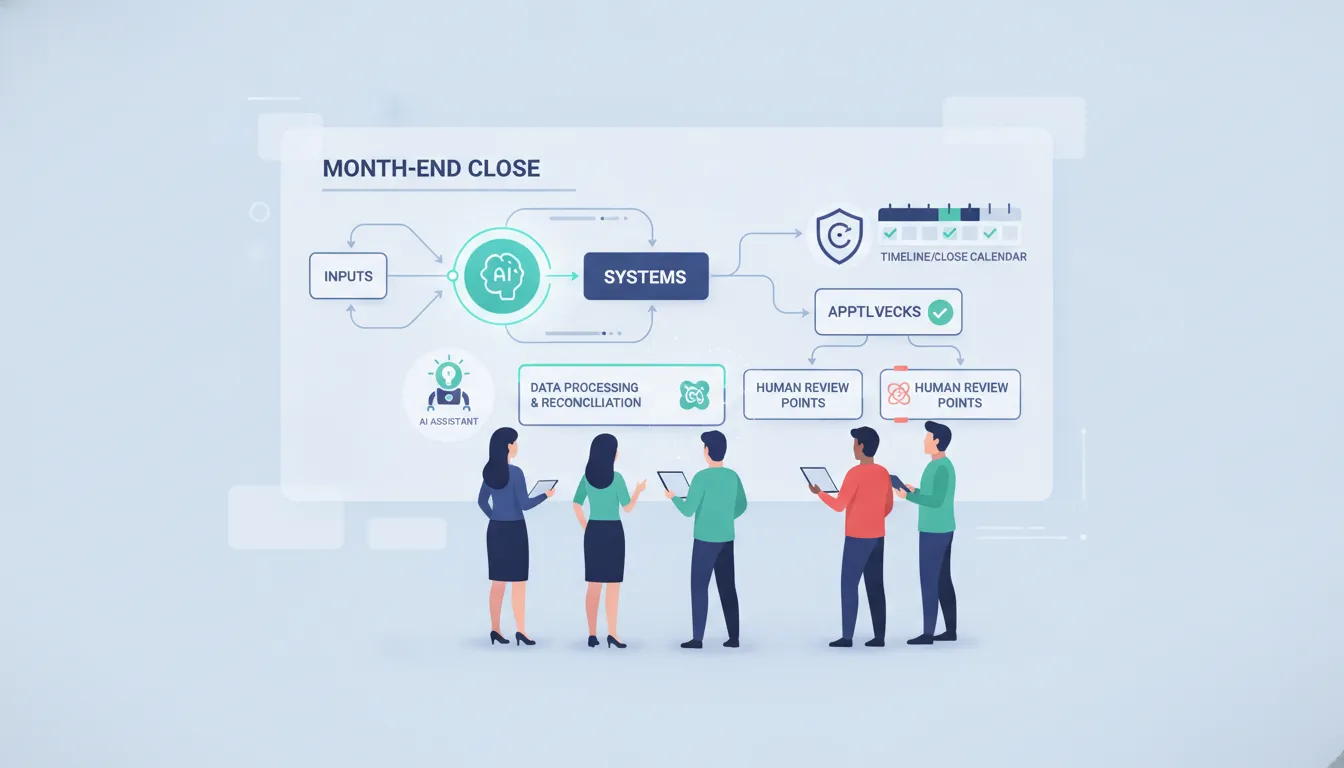
- Map the current process. Document the key close activities, inputs, approvals, systems, bottlenecks, and recurring pain points.
- Choose a repeatable problem. Begin with a task involving routine data processing, comparison, reconciliation, or aggregation.
- Define the human review point. Decide what the accountant will review, approve, investigate, or override.
- Set a measurable objective. Track improvements such as reduced preparation time, faster completion, fewer manual handoffs, or improved documentation.
- Build the process into the operating model. Make sure ownership, controls, and documentation evolve alongside the technology.
- Expand from proven use cases. Apply lessons from the initial workflow before moving into more complex processes.
A tangible example is often the best way to turn AI from a vague concept into a credible business case. Teams are more likely to support adoption when they can see exactly how a workflow changes, what the accountant will review, and where the capacity savings will come from.
Common Mistakes When Using AI for Accounting
Treating AI as a substitute for review
AI-generated output should not bypass accounting judgement. The technology can assist with preparation, pattern recognition, and analysis, but people must retain responsibility for reviewing conclusions and resolving exceptions.
Buying technology without a clear process use case
Technology alone does not fix unclear ownership, undocumented procedures, or fragmented data. Identify the specific business problem first, then evaluate how a tool can support a better workflow.
Ignoring governance and documentation
Accounting teams should be able to explain how a process works, what controls apply, and how results are reviewed. As AI becomes more integrated into finance operations, documenting these elements will be increasingly important.
Focusing only on efficiency
Saving time matters, but the strategic benefit is what the team does with that time. The goal should include better analysis, stronger controls, improved audit readiness, and greater capacity to support the business.
Waiting until the organisation has already fallen behind
AI adoption does not need to begin with a large-scale transformation. Building knowledge early makes it easier to recognise useful applications, influence technology decisions, and adapt as the profession changes.
Professional Development Can Help Turn AI Knowledge Into Career Advantage
Technology skills are becoming part of modern accounting competence, much like familiarity with spreadsheets, ERPs, and other core finance systems. An accountant who understands how AI-enabled workflows apply to close and accounting operations can better contribute to implementation decisions and demonstrate readiness for more strategic responsibilities.
The FloQast Certified Accountant programme is designed to help accountants build familiarity with accounting transformation technology and AI-enabled accounting operations. The programme is free and includes CPE credits for eligible learners.
|
The Future of Accounting Is More Strategic
AI will likely make accounting departments more capable, not less relevant. By reducing time spent on repetitive processing and spreadsheet-heavy tasks, it can create room for the work that businesses need from finance teams: reliable reporting, stronger processes, informed judgement, and strategic insight.
The accountants best positioned for this shift will be those who embrace continuous learning, understand the practical limits of AI, and use technology to make their teams more effective. The opportunity is to move beyond reporting what happened and help shape what happens next.
Frequently Asked Questions About AI and Accounting Careers
What accounting tasks can AI help with?
AI can support repetitive tasks such as data processing, data entry, reconciliation preparation, spreadsheet comparisons, expense aggregation, and identifying items that need review.
Will accountants still be needed if AI automates reconciliations?
Yes. Accountants remain responsible for reviewing results, investigating exceptions, applying accounting judgement, maintaining controls, and communicating financial implications to the business.
How can an accountant begin learning about AI?
Begin by learning how AI can apply to real accounting workflows, particularly close, reconciliation, analysis, and process documentation. Focus on understanding inputs, outputs, review requirements, and business use cases.
What is the biggest career opportunity created by AI in accounting?
AI can free accountants from more manual work, creating capacity to become business partners who improve controls, explain results, support audits, and provide strategic recommendations.

